

 YouTube
 Apple Podcasts
 Spotify
 Youtube Music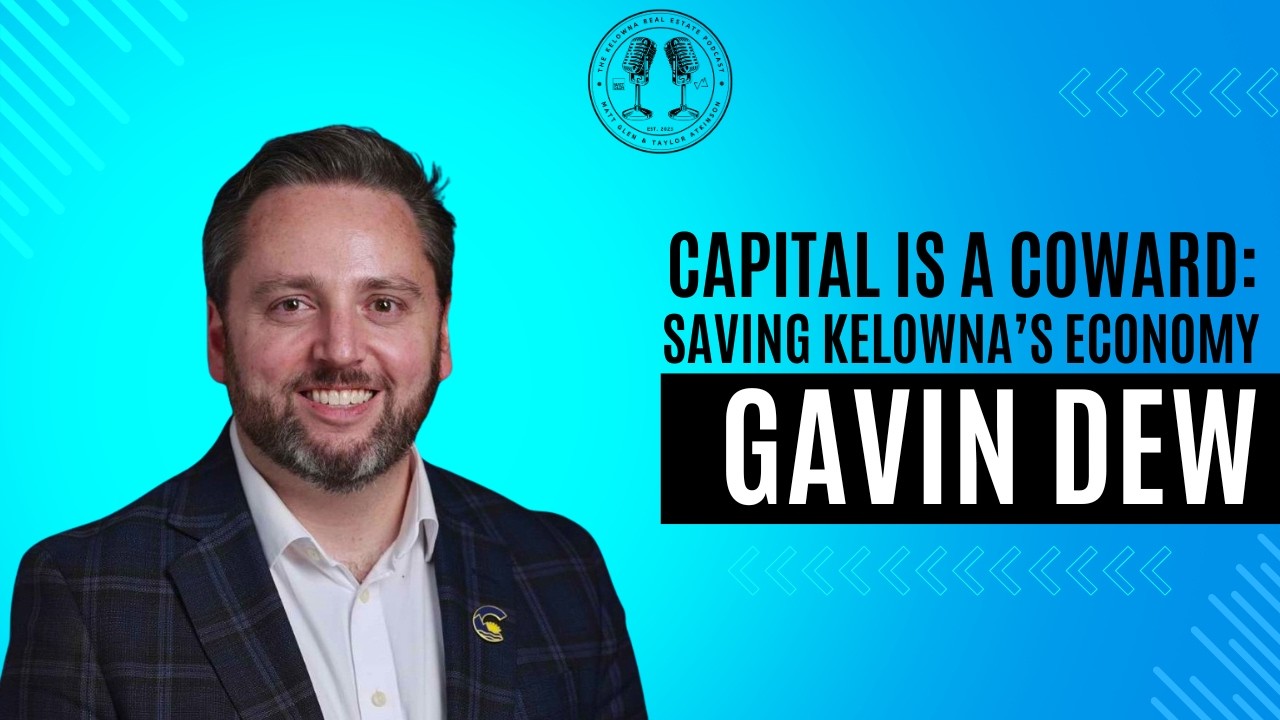
WATCH
▶️ Watch this episode on YouTube
***
EPISODE DESCRIPTION
Episode 122: Matt and Taylor are joined by Gavin Dew. Gavin is the MLA for Kelowna-Mission from Kelowna, BC, who was elected in October of 2024, and is also the Conservative Critic for Jobs, Economic Development, and Innovation (JEDI) & AI.
Born and raised in British Columbia, he is driven by a passion to renew and rebuild BC’s economic potential. Gavin’s career spans two decades at the intersection of business, public policy, and technology. He has played a key role in building public understanding and support for complex policies and projects across Canada, including affordable housing, energy infrastructure, and tech clusters. Most recently, Gavin served as Chief Strategy Officer for a $5 billion agricultural innovation and food security project in BC. He also has a strong academic background, with a BA from UBC and an MBA from the University of Oxford, where he focused on corporate social responsibility.
Prior to being elected, Gavin served on the boards of the Business Council of British Columbia and Resource Works. He has also served in governance roles with organizations like UBC, Kwantlen Polytechnic University, and Community Futures. Gavin continues to volunteer as chair of the Veterans Transition Network, a national mental health charity that played a crucial role in evacuating Afghan interpreters at risk from the Taliban. His community efforts have earned him recognition, including being named a “Forty Under 40” by Business in Vancouver for his leadership.
Gavin and his wife, Erin, recently launched Play Area, Kelowna’s newest indoor playground, to serve the growing number of young families in the Okanagan.
Gavin is here to discuss:
→ What his role is in the government as the Conservative Critic for Jobs, Economic Development, and Innovation (JEDI) & AI and holding the NDP accountable, and who he thinks will be the next leader of the BC Conservative Party.
→ If AI will help Canada's productivity crisis, the difference between digital immigrants & digital natives, and the considerations needed from government as it widens the wealth gap.
→ The integral role small businesses play in the community, and why we need to combat youth unemployment and hopelessness among gen Z to provide them a better future.
→ What would help Kelowna's economy, the importance of tourism to our ecosystem, and how getting the short-term rental (STR) exemption on June 1st is progress, albeit too little, too late for summer 2026.
→ Why "capitalism is a coward", how the lack of consumer confidence in the BC government is killing Kelowna, and if the damage can be reversed or if it's already been done.
→ Why every MLA should be made to learn economics, how governments create their own problems that they then have to fix, and the big issue of new public sector jobs outpacing new private sector jobs for years.
→ BC's provincial budget and their proposed cuts to health care, how hospitals around the province are in crisis due to terrible systems and mismanagement, and advocating for new leadership in interior health.
Gavin Dew's Website: www.conservativebc.ca/mla/gavin-dew
Gavin Dew's Instagram: @gavindew
Gavin Dew's LinkedIn: @GavinDew
***
CONNECT WITH THE SHOW
🎙️ Kelowna Real Estate Podcast: www.kelownarealestatepodcast.com
📺 Kelowna Real Estate Podcast YouTube: @KelownaRealEstatePodcast
📸 Kelowna Real Estate Podcast Instagram: @kelownarealestatepodcast
***
CONNECT WITH MATT
🌎 Matt Glen's Website: www.venturecommercial.ca/our-team/matt-glen
📬 Matt Glen's Email: matt.glen@venturecommercial.ca
📸 Matt Glen's Instagram: @realmattglen
***
CONNECT WITH TAYLOR
🌎 Taylor Atkinson's Website: www.venturemortgages.com
📬 Taylor Atkinson's Email: taylor@venturemortgages.com
📸 Taylor Atkinson's Instagram: @VentureMortgages
***
Welcome back to the Coin Real Estate Podcast. I'm your mortgage broker host, Taylor Atkinson.
00:00:04 Matt Glen
And I'm your commercial real estate agent host, Matt Glenn. What's happening to you, Taylor?
00:00:08 Taylor Atkinson
I love it. I love it. Other than just watching your success in commercial real estate grow. Today was an awesome show, man. We had Gavin Dewan while he's our local MLA for the mission in Kelowna. And so, yeah, we've been trying to connect with him for a bit. He's been advocating for short term rentals. He's representing the conservative party. And, you know, when we look back through like our show history, we've had on. a handful of MLAs, mayors, city council. So really fortunate to be able to speak with these people for such a lengthy time.
00:00:40 Matt Glen
It's also thankful for them for spending their time with us. But yeah, it was funny talking to Gavin. He's like name dropping all these people. I'm like, oh, we've had them. We've talked to them, but we've had them on the show. So yeah, it's kind of cool to do that for sure. Also, he's a good dude. He's a nice guy. Talk to you.
00:00:53 Taylor Atkinson
Yeah, I've met him a couple of times now. I think the one thing I've taken away from like the multiple shows that we've done with politicians is. You know, sometimes we color them in the same like, hey, they're part of this party or they're part of this movement. But, you know, really like we're voting for local people to then go to parliament and, you know, bring important items that are, you know, affecting our community to that provincial level. You know, we're voting for the people, not just for the party. And he's been a great resource in terms of like trying to turn up to economic drive here, right? Trying to get tourism back, trying to get like local income. to our community so we can like keep picking along here. So yeah, he was great to have on the show. We talked about a ton of different topics. So yeah,
00:01:38 Matt Glen
really good show. Talk about it on the show. He was like one of the people pushing for Kelowna to get the exemption, which worked obviously. Would have liked to see it sooner. Probably everyone else in Kelowna would have too. But he was instrumental in making that happen. It was a great episode.
00:01:51 Taylor Atkinson
Yeah, we just want to get straight to the show. Hopefully you guys enjoy it. And any of the mothers that are listening, I know my mom's a huge listener to the show, you know. So is my mom.
00:01:59 Matt Glen
is my mom. Happy Mother's Day. Yeah, exactly. Happy belated Mother's Day weekend by Teddy Eagerness. But yeah, this weekend is dedicated to you. Enjoy the show.
00:02:12 Taylor Atkinson
Okay, Gavin Dew, thanks for joining us today on the show. How are you doing? Great. Thank you for having me. I'm dialing in from Victoria today.
00:02:18 Gavin Dew
in from Victoria today. Yes. That's the only reason why I'm wearing a suit, to be honest. Somebody posted a photo of me wearing shorts the other day at an event in Kelowna, and apparently that was a big deal on the internet that there was an MLA wearing shorts, and I said, guys, it was 30 degrees. What do you want me to do? We're a top hat and tails? Come on.
00:02:37 Taylor Atkinson
Yeah. Yeah. Spring has been cooking here. So maybe we can just start with like a quick introduction, who you are and where you've kind of come from.
00:02:44 Gavin Dew
Yeah, you bet. So my name is Gavin Dew. I'm the MLA for Kelowna Mission. I serve as the conservative critic for jobs, economic development, innovation, and artificial intelligence. or jedi as it is often known they changed the name of the ministry but i kept the name of the critic role because i thought it was cool so that puts me in a place where in addition to representing colonna on a whole range of issues in the legislature I'm also very active as a critic around pretty much anything to do with the economy, jobs, economic development, trying to create economic conditions, investment conditions in the province, small business issues, innovation, AI, all of those kinds of catch -all issues are areas that I get to wade into, which is a lot of fun. I come from business myself. So those are issues I'm really passionate about and that I think it's really important to have a strong voice in the legislature. So you're the critic for AI. What are your thoughts on this? This is such a huge topic. You know, one of the frustrations about being the critic for AI is that the government appointed a minister of state for AI, I think seven months ago, and they still don't seem to have a service plan or any kind of a strategy around AI, which is a little bit problematic. But AI is such a disruptive force. so much happening there, we could spend this entire podcast talking about it. On the one hand, you have this kind of world of opportunity that's being opened up by AI, particularly agentic AI. You have people starting companies and side hustles and things like that with tremendous ease because of what they're able to do with AI. And that is just going to unlock this universe of potential opportunity and wealth creation. both in terms of standalone companies, but also just in terms of using AI in the course of your everyday normal business. And I think that's the area that people don't really yet talk about enough. It's not just about the bleeding edge of AI. It's about when people are implementing an AI receptionist, or they're using AI to write social media content, or they're using AI to generate video content, or they're using AI to help write documents, do analysis, do business planning. All of those things enable greater productivity for the people that are using AI. But there's also something called skills -biased job dislocation, which is what happens when you have an entire universe of kind of particularly entry -level white -collar desk workers who are kind of having their first jobs be shifted away or taken over by AI. So that's got some significant implications. And then on the government side, there's the big, thorny, complicated question around how can government use AI to deliver services more efficiently or better or more productively and to make the experience of citizens better? in terms of their interactions with government how can ai driven analytics be used to make government better more effective more user friendly so there's just there's such a huge universe of conversation around ai from the very positive to the really ethically troubling issues like we dealt with around the situation in tumblr ridge when it came to light that the perpetrator of that incident had potentially used chat gpt in the process of planning that terrible act such a big, complicated file. Yeah, I can imagine only getting bigger and complicated by the day. It is, right? You know, I think about, there's this terminology they used to use around technology, which was digital immigrants and digital natives. I'm going to say we're probably all roughly the same age -ish. I'm 42. You know, we probably got our first email address when we were in elementary school or high school. You know, I know I learned to type on ICQ because, you know, you could talk to girls there. We all had similar experiences of becoming technologically adapted. And then you look at the next generation that are, you know, my kids age, my kids are five and seven. And there's this video I remember seeing a couple of years ago of a little two or three year old who's been handed a paper book and they're trying to zoom in on the book and they're confused why the book won't zoom because. They've been exposed to tablet technology since earliest days of their lives. So the extent of digital native versus digital immigrant separation, AI native versus AI immigrant, just in terms of understanding and using that technology fluently. That's going to be a huge differentiator in the labor market. It's going to be a huge differentiator in terms of the ability to use those tools to do your existing job efficiently, to create new jobs and new opportunities. And there are going to be people that unfortunately get left behind. And how we manage that situation, no different than when you see technological disruptions in forestry or manufacturing or other areas, we're going to have to think about the social consequences of how we manage those disruptions. And create the opportunities while cushioning the blow for the folks that are not the winners in terms of that very rapid, quick moving AI evolution in our economy.
00:07:52 Taylor Atkinson
Yeah, it seems like it's going to be a wedge that kind of divides more of the... the wealth gap. I mean, to maybe segue into like our economy, I think about a year ago, like productivity was announced to be one of the lowest historically, like Canada as a global scale. Do you find this is going to then maybe help mitigate some of that productivity? Like maybe we can spend some time on GDP is essentially just flatline. Unemployment seems out of control, specifically to Kelowna. Do you feel like AI is going to help resolve some of this or just multiply it? I think it's probably going to create more, frankly,
00:08:26 Gavin Dew
probably going to create more, frankly, division around productivity, as you rightly pointed out. So just to baseline what you're referring to, productivity or per capita GDP, so GDP per person, has basically been flatlined in BC and in Canada over most of this century. We've seen GDP growth, but that GDP growth, particularly in BC, has been largely driven by the real estate economy. So we have seen growth again because of real estate, immigration, population growth. Our GDP has been going up, but our GDP per capita has not. So that means that people's purchasing power has not necessarily been growing. Our productivity economically in terms of our output per hour worked has not necessarily been growing. that is that we have to think actively about which industries are the most productive in terms of that per hour output. So our resource sector is dramatically, dramatically productive. We have other sectors that are a fraction of that productivity. So when we think about governments have a tendency to pick winners and losers in terms of what kinds of job growth they want to support. And it's really important that you're making those decisions on an evidence base. You're looking at what is actually going to increase our overall provincial or national productivity. How can we make sure that we are growing the kinds of jobs that are going to contribute to per capita GDP, to productivity, to the fundamental wealth creation of our province, particularly that first dollar wealth creation. And that's where the resource sector is so crucially important.
00:10:02 Taylor Atkinson
important. So obviously you guys are the conservative party opposition to NDP right now. Seems like NDP has kind of had a change of their tune recently. maybe with some housing policies and just the direction they're going. But I guess coincidentally for the conservative party as well, like you guys are having change in leadership. You kind of want to discuss maybe the differences between, you know, you guys's approach economically, like what, what are the sectors that, you know, the conservative party wants to support to see more. growth in the gdp sector i think you know part of it is about sectoral growth and part of it is also just about the approach that you take to trying to support growth so what tends to happen is that in any government in any political system hardys on the left like the ndp tend to be a little bit more focused on top -down control with this government they have a tendency to focus on picking winners and losers they love large capital projects where they can decide who goes ahead and who doesn't if those
00:10:32 Gavin Dew
think you know part of it is about sectoral growth and part of it is also just about the approach that you take to trying to support growth so what tends to happen is that in any government in any political system hardys on the left like the ndp tend to be a little bit more focused on top -down control with this government they have a tendency to focus on picking winners and losers they love large capital projects where they can decide who goes ahead and who doesn't if those projects pass their test in terms of what the labor component is, organized labor or open shop, in terms of what the indigenous equity partners might look like, in terms of what their political preferences are for projects. But when it comes to the incremental small business, they tend to be a little less focused on creating fundamental conditions for the other 95, 96 % of the economy that isn't major projects. So among other things, we're really focused on trying to rebuild our small business. business economy. You can see a sign right above my head that says save small business. We have had a really tough go of it for small business in BC under this government. We now have consistently among the lowest small business confidence in Canada. We lost 40 ,000 jobs over the last two months. We've had six straight quarters where there have been more companies exiting the economy than entering the economy. And we have had obviously a public safety crisis that has just demolished confidence among storefront small business in particular, as they have seen a wave of vandalism and violence and a loss of public safety. That's really cratered a lot of that confidence. That's really created conditions where small businesses either are closing, are quietly exiting, or are not choosing to enter. And when you don't have those small businesses, especially those storefront small businesses, that's contributing to generationally high youth unemployment, which is remaining stubbornly high in BC. So you combine that youth unemployment, those traditional entry level jobs, restaurants, retail, those kinds of jobs, the loss of those jobs combined with what's happening in terms of AI and some of those kind of higher skill, white collar entry level jobs. And you have, frankly, apocalyptic conditions for the generation that is entering the workforce right now. That's something we absolutely have to turn around as soon as possible. Yeah,
00:12:54 Taylor Atkinson
I mean, which is unfortunately a very difficult time. right? Like it just magnifies the situation where like affordability is an issue for, you know, those youth to essentially get into the housing market or just buy groceries. So it's kind of the perfect storm there. There's a real loss of hope.
00:13:09 Gavin Dew
a real loss of hope. And that's what really, really worries me. You're seeing higher levels of mental health challenges. You're seeing higher levels of suicidal ideation. You're seeing higher levels of really serious distress and alienation among young people. That's the mental health crisis that's playing out. And then equally what we're seeing is that we're losing population. So we actually had tens of thousands of people leave the province last year. We've had thousands of people leave Kelowna, frankly. So our unemployment rate went down. Because we lost thousands of people out of the workforce. You have people withdrawing from the workforce, stopping looking for work or moving to Alberta, moving to Austin, Texas, moving to Toronto, moving to somewhere else because they see opportunity there that they don't see here. So that's really almost a spiritual crisis, a psychological crisis that's contributing to the economic malaise that seems to have settled over British Columbia. What would be a like?
00:14:06 Taylor Atkinson
would be a like? Lowest hanging fruit to help our economy, Kelowna specific, Okanagan specific. What are the changes we need to implement?
00:14:14 Gavin Dew
Yeah, I think there are changes that are local. There are changes that are macro. A couple of minor things. We're obviously seeing just absolutely huge loss of confidence in land title, in the land base. So right now for anyone or anything who's attempting to build a project on the land base in British Columbia, the combination of DRIPA, which is the Declaration for the Rights of Indigenous Peoples, as well as other issues have just shaken confidence in land title and in private property rights. That's causing... a real pullback in terms of investment in physically building things on the land base. And then at the same time, again, you have that low small business confidence. You have high tax rates. The government just expanded PST onto a whole range of small businesses. So that's creating conditions where the next generation of entrepreneurs and innovators don't feel like this is where they should start a company. So that's macro level. All those things certainly affect Kelowna. I would say one of the most obvious things that we have been pushing for for a very long time to strengthen our economy locally is supporting our tourism sector. And, you know, one very important, it's not the only issue, but it's a very important symbolic issue is changing policies around short term rental toward more of a made in Kelowna solution that fits with the actual needs of our marketplace in our tourism driven economy with among the highest vacancy rates in the province, if not the country.
00:15:40 Taylor Atkinson
Yeah. And I mean, saying that, obviously. june 1st is now you know an exemption i don't want to say like a full exemption but we're moving in the right direction obviously you were a big supporter of that vocally so yeah we appreciate what's happened to me like honestly it seems yeah we're there june 1st but i think it's a little too late like the damage has been done and a lot of that is in confidence too right but at least we're moving that direction so yeah hopefully we can continue to support like the tourism now that it's coming back slightly Exactly right.
00:16:08 Gavin Dew
right. So, you know, tourism is a function of a lot of different factors, right? Obviously, we've had over the last number of years, there was a bit of a recency bias around wildfires. There was, I think, a little bit of a message that was coming out of the provincial government about wildfire season that was months long. So don't come here because it's dangerous. There was a little bit of that signaling, which I think undermined people choosing to come to Kelowna. You had fairly weak economy. You had rising interest rates. You had low economic. confidence and consumer confidence. So a bunch of different factors kind of constraining tourism. But the short term rental approach that the provincial government took was one more blow to a sector that was not performing at the level that it could be. So the changes that have come that are coming, they're overdue. Unfortunately, the way they're being implemented means we're probably still going to lose half of our summer tourism season. But thankfully, we have been able to accelerate getting an opt out. from the provincial short -term rental regulations to allow Kelowna to hopefully have more of a strong tourism season this summer. Did you spearhead that ever again? It was a work of many hands. I don't want to take more credit for that than I deserve. I will say that when I was running for office, I got elected in October of 2024. During that election, everybody was talking about the need for a made in Kelowna solution for short -term rental. I will actually give credit to Loyal Woldridge, who is a city councilor today. He was running for the NDP. He was very vocal about that. I respected the fact that he took that position. What I didn't respect is that when he took that position, the premier went out of his way to come do local media and say that Loyal was not accurate in what he was saying and that under an NDP government, there would not be a made in Kelowna solution. So there has for a long time been a consensus that what we need is a little bit more local control. control because we're not the same as Vancouver. We're not the same as every other place. And again, we've had a lot of success in Kelowna under primarily municipal leadership in delivering on and exceeding housing targets to the point where we now have a very high vacancy rate. In my opinion, and what I campaigned on, is that we should hold back from those provincial short -term rental regulations. I wanted to see that happen in the first quarter of 2025, with the goal being to enable a really strong tourism rebound last year. Obviously, we didn't win the election. I didn't get what I wanted in that regard. In November and December of last year, I brought forward a bunch of different ways through amendments to legislation, through private members' bill, and through calling on the government to use what's called an order in council or a cabinet order. I called on the government to allow Kelowna to opt out of those short -term rental regulations early so that people could start bookings effective May 1st. Ultimately, they didn't do what I asked then either, but... They did take the hint and through, I think, very strong work by the city of Kelowna in collaborating on the technical side of things. They did get to the point where they have allowed Kelowna to opt out effective June 1st. Unfortunately, effective June 1st means that on June 1st, you can begin to go through the process. If you've already registered with the city and got all that stuff figured out, you can begin to register with the province on June 1st. You can wait for them to process. registration once that's done you can then get listed on a short -term rental platform you'll typically see a four to six week you know booking timeline so if you're lucky maybe you're getting some bookings starting in mid -july so effectively Even in trying to give us a robust summer tourism season with short -term rental as part of the mix, the NDP government has actually managed to still undermine half of our tourism season, miss the Memorial Cup, some other major events, and unfortunately leave a lot of people that have been waiting a very long time waiting even longer as they bleed financially, particularly in purpose -built short -term rental developments with ACWA and other examples being the obvious ones. Is there any specifics in the legislation?
00:20:14 Matt Glen
there any specifics in the legislation? if our vacancy rate drops again, are we just all of a sudden back to being banned?
00:20:21 Gavin Dew
Yeah, that's a really, really good question. And the short answer is no, but who knows? You know, you touched earlier on the loss of confidence and that's the real thing. So when this legislation was enacted, as far as I could tell, they didn't think through what happens when somebody meets the qualifications to opt out. Because Kelowna effectively was the guinea pig who was... attempting to opt out and no process seems to have been constructed for them to do so. So they were literally having to kind of make up this process on the fly of how they would opt out. Thankfully, due to the leadership of the city of Kelowna, they are now establishing a practice that if other municipalities opt out, they will be able to opt out earlier in the year, not November 1st. So you don't miss that summer tourism season. That's a win. And that's a precedent set by the city of Kelowna that I think we could be proud of. But again, There was seemingly no plan for what actually happens when a city is ready to opt out. As it stands, once you've opted out, there is no automatic opt back in. The problem is the accumulation of different unpredictable changes to law and regulation around housing and other issues under this government, I think has destabilized confidence. So even if... you were thinking of investing in presale, if you were thinking of investing in any kind of real estate product, part of you is questioning, am I next? is the government going to change the rules on me next? And then when you combine that with the uncertainty around property rights and land title created by DRIPA, the Cowichan case, and other kind of major developments, what you've got is this nervousness where people are not quite 100 % sure that they own their property. And they're not quite 100 % sure that their property rights are secure. And they're not quite 100 % sure the government's not going to come along and rip the rug out from under them after they've made a good faith decision to make a retirement investment or to purchase a home on the expectation of being able to have a revenue stream off of part of that home. That nervousness is a really big contributor to weak economic confidence. If you don't feel like you have stable, predictable investment conditions that are going to have respect for the rule of law, respect for the idea that laws should be clear, predictable, and forward -looking, respect for your fundamental property rights, and hopefully an understanding of how basic commercial economics actually work. you might go invest somewhere else. That's a really serious problem that we're facing across the board in this province is that capital is a coward, right? Capital goes where it can seek a predictable risk -adjusted return, having knowledge of what those conditions are going to look like and hopefully having those conditions be predictable and friendly. And when that's not the case, then people don't make decisions to invest and the wheels of the economy slow down. So that's a really big challenge that we're going to have to overcome as a new government in the future tries to rebuild economic confidence and send the right signals that this is a place that people should come and invest and do business and start companies and create jobs and build their futures.
00:23:36 Taylor Atkinson
Yeah, I think, unfortunately, some of the damage that was done over the last couple of years is the narrative in the media from it. And even now, it's like we're so short -minded or short -sighted that like, yeah, oh, great. Short -term rental is coming back June 1st. Why was it gone in the first place? Like, it's almost like governments are coming out as a hero to be like, woohoo, we've accomplished something so great. We're giving you back something we took away from you.
00:23:56 Gavin Dew
something we took away from you. Yeah. I mean, here's some of your tax dollars, right? Like, there's no such thing as government money. There's only taxpayer dollars, right? That is a bit of a tendency with any government, not just this one, is that tendency to kind of take rights away from you or take money away from you and then give it back to you and ask for a standing ovation.
00:24:17 Taylor Atkinson
I think the narrative that was built up is, hey, these people that own short -term rentals are bad. They're buying pre -sale. I was signing them. Yeah, like vacancy tax, speculation tax, capital gains. It's always like penalizing the person that's sticking their neck out and trying to do something great. Instead, they could turn the table a little bit and say, hey, these people are actually like stimulating the economy. These people are allowing pre -sales to get going. If we continue to support them, there could be more units. Now, I'm not naive to the fact that like, yeah, short -term rental ban and, you know, a lot of the policy changes and volatility and lack of confidence that they've come out with has probably like gotten to what they ended up wanting, right? Like a vacancy. They wanted rents to be suppressed. Like they have achieved that, but I guess at what cost? I feel that they could have achieved the same thing if they pushed the opposite narrative to support investors and like support stimulating the economy. So it's just frustrating to see is like. you know, a person sitting on the sidelines being like, why are these headlines looked at so positively now when like the problem was created from the same party? It's a really good point,
00:25:20 Gavin Dew
really good point, right? Governments tend to create problems and then come up with ways to solve those problems. You know, the metaphor is you squeeze a balloon, it gets big in another place, then you squeeze it and then it gets big somewhere else and you keep squeezing it and eventually it pops. Sometimes that's the way that this kind of revolving door of policy choices ends up playing out is First, you create a problem and then you come along and you try to solve it. I think you're right to point to the fact that, you know, when it comes to building rental housing stock, you know, we're all economically savvy enough to understand that ma and pa investors are a really important part of doing that. People have to have sufficient economic confidence to want to invest. They have to have sufficient confidence in a balanced residential tenancy act to want to bring their lock off suite. into the market. They have to have confidence that they should invest in order to build. That's really important. There's a balance that has to be struck of course, and that's very, very important. But you also have to think about it from kind of an overall economy perspective because the economy fits together. If you've got slightly cheaper rent in an apartment, but you can't get a job because you were hoping to get a job in the tourism sector and the tourism sector isn't performing as it should, then... you know that's a trade -off there are always trade -offs there are no such thing as perfect economic outcomes you're always wrestling with how those things fit together so you know just last week i brought a private member's motion to the legislature to require all mlas to get mandatory economic literacy training when they're sworn in as mlas you know is it a little bit of a poke in the eye sure it is but it's also very intentional in that like As legislators, we are making decisions that profoundly affect the economy, that profoundly affect how job creators act in the economy, that affect how individuals act in the economy. And honestly, there is a stunning level of economic illiteracy at play in some of the decisions that get made. As the critic for what I'm the critic for, jobs and economic development, I go into budget estimates or I go into committee stage on a bill. And you find yourself asking questions and you get answers that are a little terrifying that if somebody gave you that answer in your business, they probably wouldn't be working in your business for very long. These are folks that are in charge of setting the parameters for every business in the economy. So I do believe that if we can lift the level of economic literacy in the legislature. Even if people are coming at things from different perspectives, to me, economic literacy is not let's make everyone read Milton Friedman and quote it back chapter and verse. It's let's make sure that people understand inflation. Let's make sure people understand supply and demand. Let's make sure people understand the effect of taxes. Let's make sure people understand the basics of how. you know, things are affected by other things in the economy so that they can have a more informed conversation that isn't just based in good intentions, but is also ideally based in good economics.
00:28:20 Taylor Atkinson
And I do respect like as much as I can respect it as, you know, NDP comes up with a policy and maybe they realize like, hey, it's not working. Let's change as much as like I don't like the volatility. But in terms of like where we are as a deficit, budgeting, like economically as a province, it's. awful. So for them to come out and actually like lean the other direction and say, okay, we need to make some budgetary cuts here. I'm like, okay, I can respect when someone, you know, puts up their hand and take some accountability to it. Where I'm seeing some of those cuts spoken about right now is actually in healthcare, which to me is like unbelievable. So anyone that's probably voted NDP wanted the social services of healthcare and education, but like to now cut a basic necessity, like healthcare just seems wild. So can we spend a little bit of time? Like I know they're in the earlier stages, but they're supposed to be quite a significant, you know, job cut from interior health. And I think our healthcare system is already underwater. So yeah, do you just want to spend a little bit of time? Talking about where we're at there. You bet.
00:29:26 Gavin Dew
bet. So it's on the overall budget. You know, the budget came out a couple of months ago. I was one of the three MLAs in what's called lockup. That's basically an embargo, three or four hours you get to review the budget. And then that prepares you to be able to comment on it as soon as it becomes public. So we were helping our finance critic, Peter Milibar, to get ready to comment on that. And, you know, when you start looking through that budget, wow. It is crazy. Obviously, you got a $13 billion deficit, but you also had this $650 million a year expansion of the PST onto bookkeeping, accounting, geosciences, security services, real estate. Yeah, exactly right. If you're a downtown business and you've been suffering the effects of this kind of wave of vandalism and violence unleashed by a reckless drug decriminalization experiment, and you're paying more for security services, now you're paying 7 % more for those security services. Heck, if you're, you know, an elderly person who likes to knit, you're paying 7 % more for knitting yarn. because PST was added to knitting yarn. That's how much they're scrounging in the couch cushions to find dollars. But the reason they're doing that is in part because they've grown the size of the public sector by lots of ways to measure it, but north of 40%. There's been about 10 times the rate of growth of public sector jobs relative to private sector jobs over the last number of years. There's been the worst private sector job growth in the country over the last six years here in BC. the economists will tell you you need to grow you know five private sector jobs for every public sector job in order to have a sustainable ratio and we've been going the exact opposite direction so Government has grown dramatically. A lot of that has been kind of in middle management. So when it comes to healthcare, a lot of it has been in kind of the corporate overhead side. There's been a huge amount of spending on consultants. There hasn't seemingly been that much of an improvement in terms of frontline care and particularly in terms of the conditions for the individuals working in the healthcare sector. So, you know, we're seeing a tremendous level of burnout, frustration, people leaving the system, some really, really challenging working conditions for our frontline. healthcare workers, which are contributing to destabilizing the system. You know, we have really great people that are working in the system, providing an excellent level of care, but they're doing it in hallways and they're doing it experiencing burnout and they're doing it with what seems to be a very broken organizational culture. So there's got to be a really fundamental turnaround of our healthcare system. We just saw a number of long -term care facilities be quote repaced in the budget. We found information and made it public over the last few days that repaced actually meant canceled. So they've now canceled all the contracts on those projects. There is no clear indication as to if or when those will ever move forward. They've also canceled an entire hospital in Burnaby. And of course, at Kelowna General Hospital, I've spent a lot of time over the last few weeks pointing out that we are at peak. We've got about 50 people in hallway beds at KGH, and we have unopened space. lock and key on the fifth and sixth floors that could accommodate probably about 50 to 55 beds so we've literally got shell space sitting there empty for more than a decade that was built in order to accommodate the growth in demand the demand growth has come the spaces have not been opened so we've got people that are being treated in hallways without privacy without dignity and without the quality of care that they deserve why are those places opened but what's the reasoning behind that
00:32:53 Matt Glen
are those places opened but what's the reasoning behind that
00:32:56 Gavin Dew
You'd have to ask the Minister of Health. She actually came to Kelowna last Friday and quietly visited Kelowna General Hospital, told nobody, didn't tell the media. They found out she was coming. They asked why, and there was no response. So really, at the end of the day, that's up to the Minister of Health and Interior Health to make decisions around if and when and how they're going to get those spaces open. But they're sitting there. You know, I talk to a lot of people, whether they're frontline workers in the healthcare system, doctors, nurses, allied health professionals, you name it, or whether there's people that have... through the hospital experience themselves. And the frustration you hear from 70 -year -olds who are waiting to get treatment, they're in an emergency room waiting for a hallway bed that's currently full of someone who's coming down from an overdose. I talked to someone the other day who spent several days in a hallway staring down the hall at the unfinished space. So when people become aware that they're having this experience and that there is literally space. city mayor, which is designed to be used in order to accommodate the growth in demand, and it's not being opened. That is just insulting to the taxpayers who paid for that space to be built and to the users of the healthcare system who are receiving, frankly, a disgraceful level of care by no fault of those frontline healthcare workers, but because the system is not setting it up for success.
00:34:16 Taylor Atkinson
I mean, we just had Mayor Tom Dias on last show as well, and I kind of... ask this question, but I know the answer, but at a municipal level, can we not like add to that? Like, you know, Kelowna is a profitable city. We have the airport, like we're doing fairly well. Can we not just say, yes, we have an issue. Like we're going to contribute monetary value to like. bring up that standard? Because obviously we're not getting it from the province. Like, is there any other solution that we can do as like a municipality? There are obviously significant contributions that come from the community,
00:34:43 Gavin Dew
are obviously significant contributions that come from the community, both from a tax perspective and also from a voluntary perspective, you know, through foundations, right? And so forth. So yes, but is that a sustainable solution? That's the challenge. We have a healthcare system that... is dramatically underperforming, that appears to be, frankly, very badly mismanaged, that appears to be in dramatic need of a turnaround, it's not just about spending more money. Our health budget accounts for order of magnitude 60 % of the spending that we do out of the entire budget. It will eat 100 % if you let it. You don't want to go making dramatic cuts, but what you do want to do is you want to make sure the money's actually being used effectively. And that's one of the big challenges is how do you do that turnaround? You know, we had a big issue around pediatrics last year, which I was quite vocal around, in my opinion at the time, the need for the then CEO of Interior Health to make way for new leadership. And the argument I made at the time was you can't do a turnaround on your way out the door. And I think that reality holds more broadly. We have a provincial government that is nine years in, that has clearly run out of ideas, that I think has run out of energy, that has increasingly run out of permission from the electorate. Every day there's a new poll showing them sliding further, collapsing further, losing more and more confidence on more and more issues. I really don't think that a government that is battling for its very survival and a premier that is trying to hang on to his job are really in a position to make thoughtful changes to the way we run a complex system like healthcare. So, you know, we're going to need a new government. We will get a new government sooner than later. I believe it will be a Conservative Party of British Columbia government, and it will be incumbent on us to show that we are a government in waiting, to show that we have a clear plan around how we're going to turn around. a lot of things, including our healthcare system. And then, you know, if we do that, you'll be granted the opportunity to get in there. And that affords you kind of a fresh mandate. Because when you have a new government, when you have a new minister, when you have a change moment, it allows you to look back on everything that wasn't working. And you get to say that wasn't working. You don't have to pretend it was always working because it was your idea. You don't have to kind of mess around. You get to say, okay, now it's time to turn the corner. You get to have conversations with fresh eyes. You get to invite feedback. You get to bring people into the conversation that might have felt marginalized from the conversation, especially those frontline workers that have great ideas, those doctors that have been begging to help for years and feeling shut down. You get to invite them in and you get to actually have a change moment. institutions like your health authorities and hospitals, which can hopefully get you onto that right track.
00:37:25 Taylor Atkinson
I want to finish off with one hot seat question for you. Speaking about change, who will be the new leadership of the Conservative Party? I mean, you don't have to answer this, but who are you thinking support -wise? What direction are we going?
00:37:37 Gavin Dew
Yeah, so look, we have five great people that are still in the running to be leader of the Conservative Party of BC, and every single one of them would be a lot better premier than David Eby. I know that for sure. I know that whoever becomes the new leader of our party, I will be ready, willing and able to work with them to make sure that they're successful. And I think I can say the same for our entire caucus. We've got 38 people in a caucus that want to work together, that want to be a government, want to be a government in waiting and that want to work with a new leader. So over the next few weeks, it's going to come down to that final kind of tug of war over who is ultimately successful. And then from there, my hope is that we're going to. be able to very quickly get them integrated into our caucus team, get them fully up to speed and kind of have their new leadership build even more on the momentum that Trevor Halford has built as interim leader, picking up from John Rustad. Trevor's been an incredible, incredible, very effective interim leader who's really stabilized the organization, stabilized the caucus. We're debt free. We're high functioning. We're taking it to the NDP every day in question period under his interim leadership. So whoever is coming. is going to be really well positioned. I've made it public that I'm supporting Peter Milibar, who is currently our finance critic. Peter is the only one of the candidates who currently has a seat in the legislature, which I think is a pretty compelling structural advantage because it means he can start on day one. He knows the caucus on day one. He knows the books. He knows the issues. He knows, you know, he is very familiar with the operation on day one. Obviously, I'm very hopeful that Peter will be the successful candidate, but I've got good relationships with pretty much everyone who's running. And I think what really is going to be the most beneficial is, frankly, if all five of those people are involved in whatever capacity they want to be involved when we're done. because job number one of a new leader is to rally everybody who ran for leader everybody in caucus and frankly everyone who joined the party everybody who wants a brighter future for our province without an ndp government it's the job of that new leader to gather all those people to you know throw the tent walls open to invite them in to welcome them and to rally those troops get us to an election as soon as possible where we can get a change in government and we can I'll put our folks up against theirs any day. And I am confident that we're going to win a big. big, massive majority mandate and get this province back on track.
00:40:28 Taylor Atkinson
I like the confidence. Well, Hey, we appreciate what you're doing in the Kelowna mission, you know, being a voice down there and, and wearing shorts. So, um, shorts and hoodies. Yeah. Yeah. We know, we know you got to run, but yeah, always appreciate the insight that you have. So thank you so much for doing. Thanks a lot for spending. Thanks for taking the time. I appreciate what you guys do.
00:40:48 Gavin Dew
appreciate what you guys do. Have a good one.